7 Aug 2026, 10:01 UTC144 views10 reactionsread 8 August 2026 Benchmarking and developing large language models using one million clinical trials 🔥
https://www.nature.com/articles/s41746-026-02933-7
Here, we introduce TrialPanorama, a large-scale structured resource aggregating 1.6M clinical trial records from fifteen global registries linked with biomedical ontologies and literature. Using this resource, we construct 152K training and testing samples spanning eight clinical …
❤4👍3🔥3
4 Aug 2026, 15:10 UTC178 views29 reactionsread 8 August 2026 Posted without readable text
❤13👍8🔥7❤🔥1
4 Aug 2026, 08:08 UTC248 views7 reactionsread 8 August 2026 The past, present and future of self-driving laboratories
https://www.nature.com/articles/s41570-026-00847-2
This Review traces the evolution of self-driving laboratories and examines the structural asymmetries that limit their maturation into shared scientific infrastructure. We frame the next phase of the field around three interdependent requirements: scalability, generalizability and provenance-complete experim…
❤3👍2🔥2
29 Jul 2026, 15:33 UTC353 views41 reactionsread 8 August 2026 Posted without readable text
🔥24❤8👍8🎃1
25 Jul 2026, 10:12 UTC390 views14 reactionsread 8 August 2026 Photo
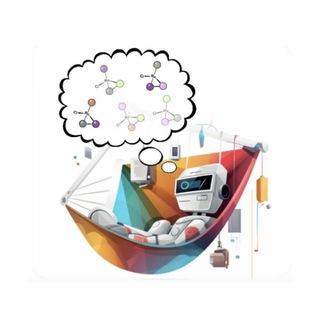
Do Language Models Dream of Binding Molecules? Benchmarking LLMs under Spatial Constraints🔥
https://arxiv.org/abs/2607.18144
In this work, we systematically analyze whether current general-purpose LLMs are capable of navigating complex 3D constraints compared to established baselines such as specialized diffusion models.
We consider 3D ligand generation conditioned on protein pockets together with ligand- and inte…
❤6👍4🔥4
22 Jul 2026, 14:27 UTC391 views11 reactionsread 8 August 2026 Yield Smarter, Not Harder: Good Practices for Machine Learning of Reaction Outcomes
https://doi.org/10.1021/jacs.6c02213
Reaction yield prediction is a longstanding challenge in synthetic chemistry, with broad implications for route planning, scalability, and high-throughput experimentation (HTE). While recent machine learning (ML) approaches have demonstrated promise in modeling reactivity, they often use complex …
👍5🔥4❤2
21 Jul 2026, 08:16 UTC347 views11 reactionsread 8 August 2026 Data-Driven Insights into Ionic Conductivity in High-Dimensional Sodium Battery Electrolytes
https://doi.org/10.1021/acsenergylett.6c01023
The discovery of advanced battery electrolytes is challenged by the vast compositional space of multi-component liquid formulations. Here, we introduce the ELectrolyte Laboratory for Integrated Experimentation (ELLIE), an automated platform that combines electrolyte formulation …
👍5❤3🔥3
17 Jul 2026, 11:10 UTC697 views35 reactionsread 8 August 2026 Photo
https://chemrxiv.org/doi/10.26434/chemrxiv.15006080/v1
Коллеги из 🏛ИОНХ РАН, 🏛ИНЭОС РАН и Университета Барселоны выложили препринт про BLIND (Bimodal Learning from Imperfect NMR Data) — трансформер, который переводит спектры ¹H и/или ¹³C ЯМР напрямую в молекулярную структуру (SMILES).
Что делает работу интересной:
Модель не получает ни брутто-формулу, ни набор возможных фрагментов, ни элементный состав — только то…
❤17🔥12👍6
13 Jul 2026, 08:02 UTC426 views9 reactionsread 8 August 2026 Strategies for Identifying Molecules of Interest in Large Chemical Spaces 🔥
https://pubs.acs.org/doi/10.1021/acs.jcim.6c01496
Searching in ultralarge Chemical Spaces with known 2D similarity metrics, like fingerprint-based Tanimoto, substructure, or pharmacophore similarity searches, contains pitfalls due to the representation of molecules as synthons with connectivity rules.
Applied to a set of almost 3000 drug-r…
👍4❤3🔥2
11 Jul 2026, 15:06 UTC418 views39 reactionsread 8 August 2026 🎊 Наш LLM-бенчмарк по растворимости SoluBench сегодня доехал до 📕 JCIM: https://pubs.acs.org/doi/10.1021/acs.jcim.6c00677
Это первый раз в нашей практике, когда за время рецензии в журнале результаты успели устареть минимум дважды — так как на момент сабмита у нас самая свежая модель была Opus 4.6, а сейчас уже во всю работают 4.8 и Fable :))
А еще у нас с JCIM'ом закончилась целая сага с серией desk rejection по п…
❤20🔥11👍8
10 Jul 2026, 13:29 UTC348 views10 reactionsread 8 August 2026 In Silico ADMET: From Current Practices to Novel Profilers
https://pubs.acs.org/doi/10.1021/acs.jmedchem.6c00049
We introduce OneADMET, a meticulously curated data set of 738,161 compounds with 1,119,719 measurements spanning 44 ADMET end points and 1 489 biological activities. We report a unified ChemProp-based MTL model capable of handling hundreds of continuous tasks simultaneously, which has practical advantage…
👍4❤3🔥3
9 Jul 2026, 15:16 UTC342 views24 reactionsread 8 August 2026 Photo
Фантастика, конечно.
Если бы мне кто-то в 2020 году сказал, что в 2026 можно будет одним запросом "Дай мне SMILES", получать SMILES всех комплексов с такой картинки (и без ошибок) с помощью модели, которую на это даже не файнтюнили — я бы не поверил.
Про целесообразность, правда, отдельный вопрос. Потому что Opus 4.8 в low-режиме съел 6% пятичасового лимита токенов на это :)
🔥17👍4😁2❤1
Showing the 12 most recent of 17 posts we hold for @chem_ml. View and reaction counts are the latest single reading for each post, not a live figure, and a recent post is still accumulating both. A view count marked ≈ was rounded by Telegram before we ever saw it — t.me prints views in full below 1,000 and to three significant figures above, so ≈1,200,000 means somewhere between 1,150,000 and 1,249,999. Unmarked counts are exact. Text is reproduced from the public post preview and truncated for length.